
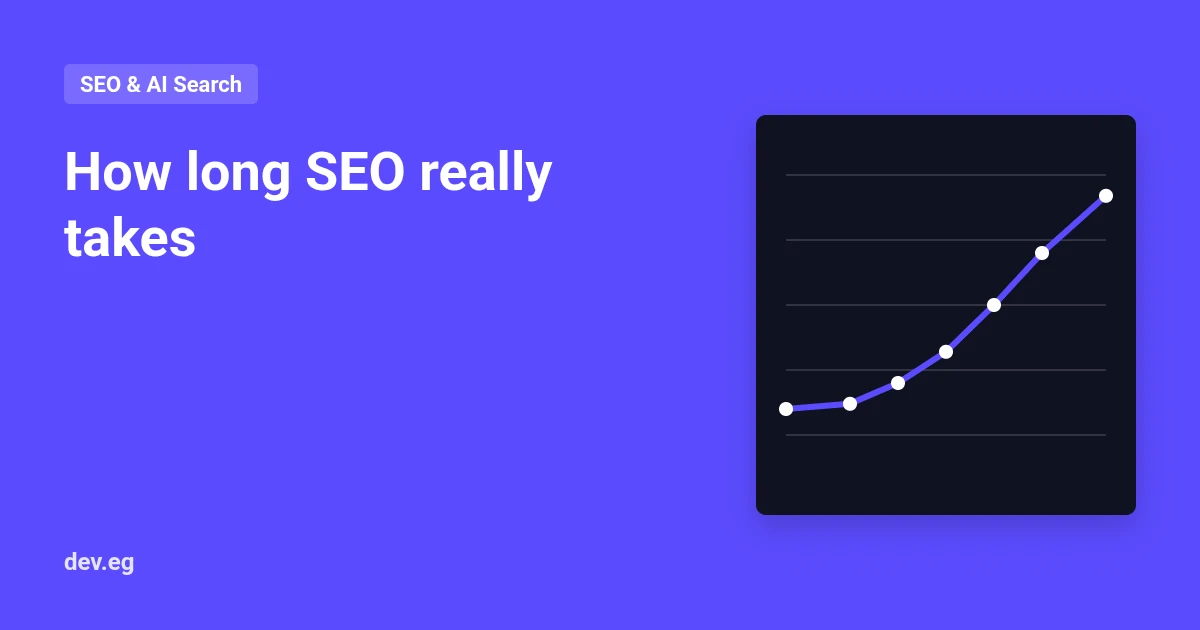
Short answer: on an established website, technical fixes and better pages usually start to show in Google within one to three months. Competitive keywords take six to twelve months, and a brand-new domain often needs most of a year before it earns steady traffic. Google itself tells businesses to expect four months to a year from the start of SEO work to the first real benefit.
Anyone who promises page one in two weeks is either targeting words nobody searches for or doing something that will hurt you later.
Typical timelines by situation
| Situation | When you usually see movement | When it usually pays off |
|---|---|---|
| Fixing technical problems on an established site (indexing, speed, broken pages) | Days to weeks | 1 to 3 months |
| New or improved pages on an established site | 2 to 6 weeks | 2 to 4 months |
| Local search and Google Business Profile | A few weeks | 2 to 4 months |
| Competitive national keywords | 2 to 4 months | 6 to 12 months or more |
| A brand-new website or domain | 2 to 3 months | 6 to 12 months |
| Recovering from a redesign that lost traffic | Weeks, once fixed | 2 to 6 months |
Why it takes time
- Google has to crawl and re-evaluate your pages. Large or slow sites are crawled less often, so changes take longer to be noticed.
- Trust builds slowly. New domains have no history, few links and few mentions. That changes over months, not days.
- Competitors are not standing still. On a crowded keyword you are trying to move past pages that have been improving for years.
- Content needs time to collect signals. A new article first ranks for long, specific searches, and climbs to broader ones as it earns clicks, links and mentions.
What a realistic first year looks like
- Month 1: audit, fix crawling and indexing problems, set up Search Console, Bing Webmaster Tools and Analytics, agree the keywords that matter to sales.
- Months 2 to 3: improve the main service pages, publish the first useful articles, fix internal links. Impressions in Search Console usually rise before clicks do.
- Months 4 to 6: long, specific searches start sending visits and enquiries. Weak pages are rewritten based on real data.
- Months 6 to 12: broader, more competitive terms move up. This is when SEO tends to become a dependable source of leads.
What speeds it up
- A technically clean site: fast, mobile-friendly, every important page indexable.
- Pages that answer the question better than the current top results, with real figures and examples.
- Steady publishing rather than ten articles in one week and nothing after.
- Mentions and links from respected sites in your industry and region.
- Arabic pages. In many sectors there is much less good Arabic content, so the same effort moves faster.
What slows it down or reverses it
- Bought links and automated content. They can work briefly and then cost you months.
- Redesigns that change URLs without redirects. See our guide to redesigning without losing Google traffic.
- Thin pages written for keywords rather than people.
- Stopping work too early, usually around month three, just before results start.
How to tell if it is working before sales arrive
- Impressions in Google Search Console rising for the keywords you target.
- Average position improving for those keywords, even if still on page two.
- More pages receiving at least some search traffic.
- Enquiries from organic visits, tracked as key events in Google Analytics.
If you want an honest estimate for your site and market, book a free call or start with a free SEO audit. You can read how we work on our SEO agency page.
Frequently asked questions
Can SEO show results in one month?
Fixes to serious technical problems can show within weeks. Ranking for competitive keywords in one month is rare.
Is SEO faster for Arabic keywords?
Often, yes. Competition for Arabic searches is usually lower, especially in B2B sectors.
Should we run Google Ads while SEO builds up?
For most businesses, yes. Ads bring enquiries from day one and show which keywords actually convert, which helps the SEO plan.
When should we stop SEO?
You can reduce it once you rank well, but competitors keep working, so most companies keep a lighter, ongoing effort.
Does AI search change these timelines?
Not much. AI answers mostly cite pages that already rank, so the same work applies. Read GEO and AEO explained for the details.
Checked on 24 November 2026. Source: Google Search Central, “Do you need an SEO?”.
About the authors. This guide was written by the consultants at The Egyptian Developers (TEDs), an Odoo Gold Partner, Google Premier Partner and Bing Elite agency working with companies in Egypt, the Gulf, Libya and the UK since 2000.
Book a free callMessage us on WhatsApp